Stuck choosing a college essay topic?
A free tool that reads what you already have and tells you which Common App prompt fits it best — takes about five minutes, no account needed.
Find your prompt →How to use it
- Open the tool. It asks a few small, specific questions about something that actually happened to you — no essay required, and nothing to prepare in advance.
- Get your result: the Common App prompt your material fits best, scored against the other prompts so you can see why.
- Come back here. The tool opens in a new tab, so this page stays right where it is.
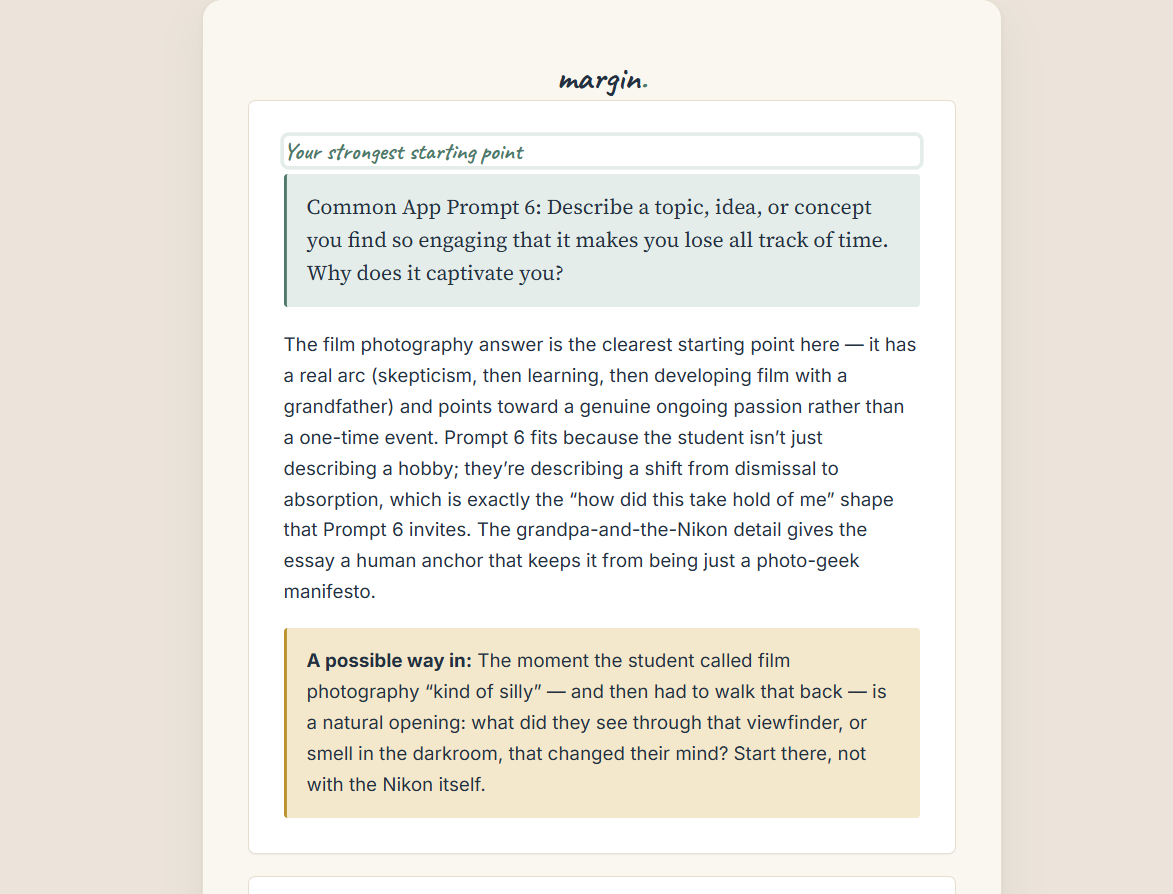
Your result will look something like this. Click to enlarge.
Go find your prompt, then come back — the article below covers how to tell whether the topic you landed on is the right one to commit to.
Find your prompt →How to actually choose a topic
Most students don't get stuck because they have nothing to write about. They get stuck because they think the topic has to be impressive before it's worth writing about at all.
It doesn't. It has to be true.
Here's what that actually means, and how to find it.
Start with what you'd tell a friend, not what you'd tell an admissions committee. If someone asked you to describe something that actually happened to you — not your biggest achievement, just something real — you wouldn't reach for your most impressive accomplishment. You'd reach for something specific: the time your car broke down and you had to figure it out alone, the argument with your dad that changed how you saw him, the summer job that taught you something about yourself you didn't expect. That instinct is usually right. The essay that sounds like you talking to a friend almost always beats the one that sounds like you performing for a stranger.
Small is not the same as unimportant. A lot of students rule out their best material because it doesn't feel "big enough" — no tragedy, no dramatic turnaround, no obvious lesson. But admissions readers aren't looking for the size of the event. They're looking for the size of your thinking about it. A quiet, specific moment you've actually reflected on will always beat a big moment you're just narrating.

The questions are deliberately small and specific — that's where real topics come from.
Notice what you keep circling back to. If you've tried to write about three different things and one of them keeps showing up even when you're trying to write about something else, that's a signal. It usually means that thing actually matters to you, whether or not it seems "essay-worthy" on paper.
Ask what it reveals, not just what it proves. A resume proves things — grades, activities, awards. An essay is supposed to reveal something a resume can't: how you think, what you value, how you've grown, what's actually going on underneath the accomplishments. Before committing to a topic, ask: if someone read only this essay, what would they understand about me that they couldn't get anywhere else in my application? If the honest answer is "not much," that's worth noticing before you spend three weeks drafting it.
You're allowed to start before you're sure. You don't need to have the perfect topic locked in before you start writing. Some of the clearest thinking happens in the act of trying — writing a page about something, realizing halfway through it's not quite right, and discovering what the real topic was underneath it. That's not wasted time. That's how most real essays actually get found.
If you want a faster way to get unstuck, the tool at the top of this page will read what you've already got and tell you which prompt it fits best — a place to start, not a verdict.
Once you've got a topic and a draft underway, two more free tools can help: check whether your draft is actually answering the prompt, or whether it's started to sound like anyone's essay instead of yours.
Found the story. Now build the essay.
Choosing a topic is only the beginning. Margin can help you shape the idea, respond to the prompt, revise the complete draft, strengthen your voice, line-edit it, and know when it is ready — all without writing it for you.
Develop This Story With Margin — Free
Browse Resources →
Already have a draft? Check it answers the prompt → · Check it doesn't sound generic →